
Discover the profound peace of Sarnath, the cradle of Buddhism, with Travel With Monk — where exploration meets enlightenment.
Overview
Sarnath is not just a destination; it is the birthplace of one of the world’s greatest spiritual traditions. Revered as the site where Gautama Buddha delivered his first sermon after attaining enlightenment, this serene town in Uttar Pradesh is one of the four holiest Buddhist pilgrimage sites in the world.
Located just 10 kilometres north-east of Varanasi, Sarnath is where the Buddha, at the age of 35, taught his first disciples the Dhammacakkappavattana Sutta (the Discourse on Turning the Wheel of Dharma), setting in motion the Buddhist teachings that would eventually spread across the world. It is also traditionally considered the place where the Buddhist Sangha (monastic community) first came into existence.
Today, Sarnath is a peaceful spiritual retreat dotted with ancient stupas, monastery ruins, a world-class museum, and beautiful modern temples built by Buddhist communities from Thailand, Japan, China, Tibet, and Myanmar. Whether you are a pilgrim, a history enthusiast, or a traveller seeking serenity, Sarnath offers an experience that touches the soul.
History of Sarnath
The First Sermon: Turning the Wheel of Dharma
Sarnath’s place in history is defined by a single, transformative event. In approximately 528 BCE, five weeks after attaining enlightenment at Bodh Gaya, the Buddha travelled to Sarnath to share his discovery with the world.
He found his five former companions — Kaundinya, Assaji, Bhaddiya, Vappa, and Mahanama — who had previously abandoned him when he gave up extreme asceticism. At the Deer Park in Sarnath, he delivered his first sermon, known as the Dhammacakkappavattana Sutta (“The Discourse on Turning the Wheel of Dharma”). This teaching set forth the Four Noble Truths and the Eightfold Path, which became the foundation of Buddhist philosophy.
The Formation of the Sangha
At the end of this first sermon, Kaundinya attained the first stage of sainthood, becoming the first Buddhist monk. The other four disciples soon followed, and the Buddhist Sangha — the community of monks — was born.
The Ashokan Era (3rd Century BCE)
Sarnath’s significance grew immensely under the great Mauryan Emperor Ashoka, who converted to Buddhism after the Kalinga War. In 249 BCE, Ashoka visited Sarnath and erected a magnificent polished sandstone pillar. The pillar’s crowning glory was the Lion Capital — four lions standing back-to-back — which was later adopted as the national emblem of India. The capital also features four animals (bull, lion, elephant, and horse), representing the four phases of the Buddha’s life.
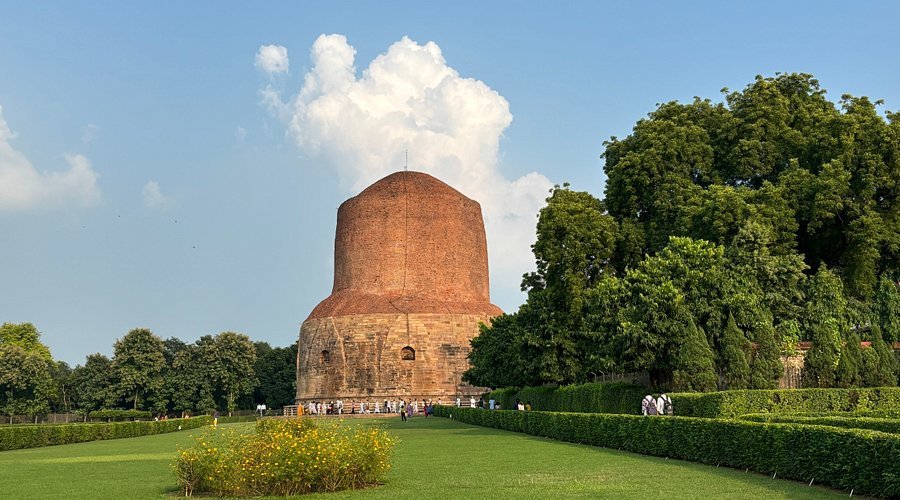
Ashoka also founded the Dhamekh Stupa on the spot where the Buddha delivered his first sermon. This massive brick stupa, rebuilt in the 5th century, remains the most iconic structure in Sarnath.
Gupta Period and Decline (4th–12th Century)
During the Gupta period (4th–6th century CE), Sarnath flourished as a major centre of Buddhist learning and art. The Chaukhandi Stupa was built during this time as an octagonal tower to commemorate the spot where the Buddha met his first five disciples.
However, Sarnath’s fortunes declined after the 12th century when it was largely abandoned and fell into ruin.
Rediscovery in the Modern Era
Sarnath was rediscovered in the 19th century by British archaeologists. The Archaeological Survey of India (ASI) began excavations in the 1830s, unearthing the Dhamekh Stupa, the Ashoka Pillar, and numerous monasteries and sculptures.
In 1998, Sarnath was included in UNESCO’s “Tentative List of Heritage Sites” and in August 2025, India officially nominated the ‘Ancient Buddhist Site, Sarnath’ for the UNESCO World Heritage List.
Geography of Sarnath
Location and Topography
Sarnath is located in the Varanasi district of Uttar Pradesh, approximately 10 kilometres (6.2 miles) north-east of Varanasi. It lies near the confluence of the Ganges and Varuna rivers.
| Feature | Details |
|---|---|
| Coordinates | 25°22′41″N, 83°01′30″E |
| Elevation | ~200 metres above sea level |
| State | Uttar Pradesh |
| District | Varanasi |
| Distance from Varanasi | 10 km |
Historical Names
Sarnath has been known by several names throughout history:
- Isipatana — meaning “where holy men fell to earth”
- Rishipattana — another variant of the same
- Mrigadava or Migadaya — “Deer Park”
Flora and Fauna of Sarnath
Flora
Sarnath is home to the famous Bodhi Tree, believed to be grown from a cutting taken from the original Bodhi Tree in Bodh Gaya. The site also features towering trees, lovely manicured gardens, and bamboo groves. The sprawling green lawns of the Deer Park provide a serene environment for meditation and reflection.
Fauna — The Deer Park
Sarnath was historically known as Mrigadava (“Deer Park”), and the tradition continues. A modern-day Deer Park has been established as a mini-zoo or open animal park, allowing visitors to see deer roaming freely.
The park houses a variety of animals and birds, including:
| Animals | Birds |
|---|---|
| Deer (various species) | Pelicans |
| Crocodiles | White-necked storks |
| Porcupines | Cranes |
| Ducks | |
| Parrots, Peacocks, Emus |
Entry to the Deer Park costs INR 20 and it is maintained by the forest department.
Religious Beliefs and Sacred Sites
Sarnath is one of the holiest sites in Buddhism, but it also holds significance for Jains, as it is believed to be the birthplace of the 11th Jain Tirthankara.
🛕 Major Buddhist Pilgrimage Sites
1. Dhamekh Stupa
The most iconic monument in Sarnath, the Dhamekh Stupa marks the exact spot where the Buddha delivered his first sermon. Built by Emperor Ashoka in 249 BCE and rebuilt in the 5th century, it stands at an impressive 43.6 metres (143 feet) in height and 28 metres (92 feet) in diameter.
2. Chaukhandi Stupa
This stupa, located 13 km from Varanasi, commemorates the spot where the Buddha met his first five disciples. It was built as an octagonal tower during the Gupta period (4th–6th century).
3. Ashoka Pillar
Emperor Ashoka erected a polished sandstone pillar in 272–273 BCE to mark the foundation of the Buddhist Sangha. The pillar’s Lion Capital — four lions standing back-to-back — was adopted as the national emblem of India.
4. Mulagandhakuti Vihara
This 100-foot-tall tower temple is believed to be the place where the Buddha stayed during his visits to Sarnath. It is a major attraction and a peaceful spot for meditation.
5. Sarnath Archaeological Museum
The museum houses a vast collection of Buddhist artifacts and sculptures excavated from the site. Its most famous exhibit is the Lion Capital of Ashoka.
6. International Buddhist Temples
Sarnath is home to beautifully crafted temples built by Buddhist communities from around the world:
How to Reach Sarnath
By Air
| Detail | Information |
|---|---|
| Nearest Airport | Varanasi Airport (Babatpur) |
| Distance from Sarnath | ~30 km |
| Connectivity | Direct flights from Delhi, Mumbai, Khajuraho, and Kathmandu |
From Airport: Taxis and app-based cabs are available for the 30 km journey.
By Train
Travel Tip: While Sarnath has its own railway station, it has limited train services. Most visitors travel to Varanasi Junction (about 10 km away) and then take a taxi or auto-rickshaw to Sarnath.
By Road
| Route | Distance | Travel Time |
|---|---|---|
| Varanasi to Sarnath | 10 km | 25–30 minutes |
| Delhi to Varanasi (via road) | ~800 km | ~14–16 hours |
Local Transport:
- Auto-rickshaws and tuk-tuks are readily available from Varanasi
- Taxis and app-based cabs offer a comfortable ride
- Regular UPSRTC buses connect Varanasi to Sarnath
Distance from Delhi to Sarnath
| Mode of Travel | Approx. Distance | Approx. Travel Time |
|---|---|---|
| By Road | ~800 km | 14–16 hours |
| By Train (via Varanasi) | ~780 km | 12–14 hours |
| By Air (via Varanasi) | ~650 km (aerial) | 1.5 hours (flight) + 1 hour (road) |
Note: There is no direct train from Delhi to Sarnath. You must travel to Varanasi Junction and then take local transport.
Weather and Climate of Sarnath
Sarnath experiences a humid subtropical climate with distinct seasons.
Seasonal Breakdown
Monthly Weather Snapshot
| Month | High/Low (°C) | Rain (days) |
|---|---|---|
| January | 21°/10° | 4 days |
| February | 25°/11° | 4 days |
| March | 31°/18° | 8 days |
| April | 36°/22° | 3 days |
| May | 42°/27° | 1 day |
| June | 41°/29° | 7 days |
| July | 34°/26° | 21 days |
| August | 33°/25° | 23 days |
| September | 31°/24° | 22 days |
| October | 30°/21° | 4 days |
| November | 30°/17° | 0 days |
| December | 22°/11° | 4 days |
Best Time to Visit
| Purpose | Best Months |
|---|---|
| Overall Best | October to March |
| Pleasant Weather | November to February |
| Avoid | April to June (scorching heat) |
Festivals
- Buddha Purnima (May): Celebrates the birth, enlightenment, and salvation of the Buddha
- Maha Shivaratri (February–March): Celebrated with devotion
Packing Guide
| Season | What to Pack |
|---|---|
| Winter (Nov–Feb) | Light woolens, comfortable walking shoes, scarf, sunscreen |
| Summer (Mar–Jun) | Light cotton clothes, hat & sunglasses, sunscreen, plenty of water |
| Monsoon (Jul–Sep) | Raincoat, umbrella, waterproof footwear |
Nearby Places to Visit
| Destination | Distance from Sarnath | Highlights |
|---|---|---|
| Varanasi | 10 km | Kashi Vishwanath Temple, Ganga Aarti at Dashashwamedh Ghat, boat rides on the Ganges |
| Ramnagar Fort | 14 km | 18th-century fort; museum with vintage cars |
| Chunar Fort | 35 km | Historic fort with panoramic views of the Ganges |
Things to Do in Sarnath
1. Visit the Dhamekh Stupa
Stand at the very spot where the Buddha delivered his first sermon. The sheer size and serenity of this 43.6-metre stupa will leave you in awe.
2. Explore the Ashoka Pillar & Lion Capital
See the iconic pillar that gave India its national emblem. The Lion Capital is displayed at the Sarnath Archaeological Museum.
3. Meditate at Mulagandhakuti Vihara
Experience the peace of this 100-foot-tall tower temple, believed to be where the Buddha stayed.
4. Visit the International Temples
Explore the Thai, Tibetan, Chinese, Japanese, and Sri Lankan temples, each with its own unique architectural style and spiritual ambiance.
5. Walk Through the Deer Park
Visit the modern-day Deer Park, where deer roam freely in the same area where the Buddha once walked.
6. Explore the Archaeological Museum
See the exquisite collection of Buddhist sculptures, including the famous Lion Capital of Ashoka.
7. Meditate Under the Bodhi Tree
Sit beneath the sacred Bodhi Tree, grown from a cutting of the original tree in Bodh Gaya.
8. Attend the Buddha Purnima Festival
If visiting in May, experience the vibrant celebrations marking the Buddha’s birth, enlightenment, and salvation.
Accommodation Options in Sarnath
Sarnath offers a range of accommodation, from budget guesthouses to comfortable hotels.
| Budget | Examples | Features |
|---|---|---|
| Mid-Range | Hotel Sarnath, The Imperial | Comfortable rooms, good locations |
| Budget | Guesthouses, Dharamshalas | Simple, affordable stays |
| Monastery Stays | Tibetan, Thai, or Sri Lankan monastery guesthouses | Donation-based or very affordable stays |
Travel With Monk Recommendation: For a wider range of hotels and luxury options, consider staying in Varanasi (10 km away) and visiting Sarnath as a day trip.
Local Cuisine — A Taste of Sarnath
Sarnath offers simple, vegetarian food reflecting its spiritual character.
| Dish | Description |
|---|---|
| Sattvic Thali | A simple, balanced vegetarian meal |
| Kachori-Sabzi | Popular local breakfast of deep-fried bread and spicy potato curry |
| Prasad | Sweet offerings available near temples |
Where to Eat
- Local eateries near the temple complex
- Monastery kitchens offering simple meals
- Varanasi for a wider range of culinary options
Frequently Asked Questions (FAQs)
General Questions
Q1: Why is Sarnath important for Buddhists?
Sarnath is one of the four holiest Buddhist pilgrimage sites and the place where the Buddha delivered his first sermon after attaining enlightenment. It is also where the Buddhist Sangha first came into existence.
Q2: What is the best time to visit Sarnath?
The best time to visit is from October to March when the weather is pleasant and ideal for sightseeing.
Q3: What is the distance between Varanasi and Sarnath?
Sarnath is approximately 10 kilometres north-east of Varanasi.
Q4: Is Sarnath safe for tourists?
Yes, Sarnath is a peaceful pilgrimage town and is generally safe for tourists. Travel With Monk ensures safe and guided experiences for all travellers.
Travel Logistics
Q5: How can I reach Sarnath from Delhi?
You can reach Sarnath by:
- Train: Take a train to Varanasi Junction (~12–14 hours) and then a taxi/auto to Sarnath (10 km)
- Flight: Fly to Varanasi Airport (~1.5 hours) and then take a taxi to Sarnath (30 km)
- Road: Drive via NH19 (~800 km, 14–16 hours)
Q6: Does Sarnath have an airport?
No. The nearest airport is Varanasi Airport (Babatpur), approximately 30 km from Sarnath.
Q7: What is the nearest railway station to Sarnath?
Sarnath has its own railway station, but the main railhead is Varanasi Junction, approximately 10 km away.
Practical Information
Q8: What should I wear when visiting temples in Sarnath?
Visitors should wear modest clothing that covers the shoulders and knees as a mark of respect.
Q9: Do mobile networks work in Sarnath?
Yes, all major mobile networks work well in Sarnath.
Q10: Are ATMs available in Sarnath?
Yes, ATMs are available, but it is advisable to carry sufficient cash.
Q11: What is the local language spoken in Sarnath?
The official language is Hindi. The regional dialect is Bhojpuri. English is understood in tourist areas.
Q12: What is the entry fee for the Deer Park?
The entry fee is INR 20.
Why Choose Travel With Monk for Your Sarnath Journey?
At Travel With Monk, we believe in curating journeys that go beyond conventional sightseeing. Our Sarnath tours are designed to foster self-discovery and spiritual enrichment through:
- Expert Guidance — Years of experience in organising spiritual and cultural tours on the Buddhist Circuit
- Local Insights — Authentic, off-the-beaten-path experiences that connect you with Sarnath’s peaceful spirit
- Spiritual Connection — Opportunities for meditation and reflection at the most sacred sites
- Sustainable Tourism — A commitment to responsible and respectful travel
- Customisation — Trips tailored to your individual interests and pace
- Transparency — No hidden charges; all services clearly communicated
Whether you seek the profound peace of the Dhamekh Stupa, the quiet reflection at the Deer Park, or simply a moment of stillness under the Bodhi Tree, Travel With Monk is your gateway to transformative journeys where exploration meets enlightenment.